

Domaine Anne Gros & Jean-Paul Tollot is the shared project of two of Burgundy's most distinguished fifth-generation vignerons, united by a shared curiosity and a desire to make wine together in a landscape far removed from their native Côte d'Or. Anne Gros, a scion of Vosne-Romanée's legendary Gros family clan, and Jean-Paul Tollot, of Domaine Tollot-Beaut in Chorey-lès-Beaune, each continue to steward their respective Burgundian estates while channeling a distinct creative energy into this southern venture. Established in Cazelles in the high-altitude hills of the Minervois, the domaine was founded in 2006 and produced its first harvest in 2008. What began as a search for new terroir became a quietly radical proposition: to bring Burgundian precision, restraint, and a reverence for place to the sun-drenched landscapes of the Languedoc. The wines that result are neither a transplant of Burgundy nor a concession to southern convention, but something genuinely their own — structured, mineral, and built for the long haul.

Terroir
The domaine is situated in Cazelles, in the uppermost reaches of the Minervois appellation, where the landscape tilts toward the Massif Central and the air carries an Alpine coolness absent from the warmer valley floors below. Bordering the Saint-Chinian appellation, the estate spans some 21 hectares across several lieux-dits organized into three distinct sectors: IGP Pays d'Hérault Côtes du Brian, AOC Minervois, and AOC Minervois Cazelles. The soils are composed primarily of sandstone and limestone — locally referred to as "Le Causse" — and the vineyards sit at elevations ranging from 200 to 500 metres above sea level. It is a detail of particular resonance that the estate's core altitude of 220 metres mirrors almost exactly that of Vosne-Romanée, a correspondence that is less coincidence than conscious alignment with what Anne Gros knows in her bones about how altitude shapes ripening. The microclimate here is notably temperate for the Languedoc, with regular rainfall and a slow, even maturation cycle that preserves aromatic finesse and natural acidity. The varietal palette reflects both region and ambition: Syrah, Carignan, Grenache, and Cinsault share the slopes with Cabernet Sauvignon, Marselan (planted in 2015), and Pinot Noir (planted in 2018). Among the domaine's most precious assets are parcels of Grenache and Carignan dating to 1909, their deep root systems and low yields contributing to wines of extraordinary concentration and complexity.
Vinification
Winemaking at Domaine Anne Gros & Jean-Paul Tollot proceeds parcel by parcel, a plot-by-plot discipline that reflects the Burgundian instinct to let terroir speak before technique. All grapes are hand-harvested and sorted with care. Fermentation relies exclusively on indigenous yeasts, allowing each vineyard's microbial identity to inflect the finished wine. Extraction is deliberately gentle, preserving texture without coarseness. Total destemming is applied across the entire range — a practice native to Burgundy that here brings definition, freshness, and structural clarity to southern varieties that might otherwise read as heavy or overripe. Élevage is calibrated cuvée by cuvée, with aging carried out in a combination of tanks and barrels suited to the character of each wine. La Ciaude, sourced from clay-limestone soils with full southern exposure, is aged in barrel to develop its characteristic silky texture and mineral persistence. Vinification proceeds with a low-intervention ethos rooted in sustainable viticulture, with close observation of each vineyard's natural cycles governing decisions in both the vines and the cellar.
Philosophy
The animating idea behind Domaine Anne Gros & Jean-Paul Tollot is one of deliberate transposition: to carry the values of great Burgundy — precision, restraint, terroir fidelity, ageing potential — into the Languedoc without imposing a foreign template onto southern soil. Anne Gros has spoken explicitly of her desire to move away from the open-knit, immediately accessible style that has historically defined much Minervois, toward wines with genuine structure and the capacity to evolve over time. This is not a rejection of the south but a deepening of it — a wager that the high-altitude terroir of Cazelles, properly understood, can yield wines of tension and complexity that reward patience. Sustainable viticulture underpins everything, with each vineyard tended in careful attunement to its own natural rhythms. The domaine's founding required years of searching before the right land was found, and that patience — the willingness to wait for the right conditions before acting — is itself a kind of philosophy. Both partners remain committed to their Burgundian roots while embracing the particularity of a place that, in its altitude, its soils, and its temperate microclimate, rhymes quietly with the Côte d'Or.
History
Both Anne Gros and Jean-Paul Tollot are fifth-generation winemakers, their respective families among the most storied in Burgundy. Anne Gros belongs to the Gros family of Vosne-Romanée, one of the Côte de Nuits's great dynastic clans, and has led Domaine Anne Gros since the 1990s. Jean-Paul Tollot helms Domaine Tollot-Beaut in Chorey-lès-Beaune, another estate of deep Burgundian heritage. The two are not married, and the joint project did not supplant their individual domaines but grew alongside them as an expression of shared curiosity. The search for the right southern terroir unfolded over several years before the pair settled on the hills of Cazelles in the Minervois. Domaine Anne Gros & Jean-Paul Tollot was formally established in 2006, though the first harvest did not arrive until 2008 — the intervening period complicated by the absence of winery facilities and protracted contractual difficulties. From those early challenges, the domaine has grown to encompass 21 hectares across multiple lieux-dits and three appellations. The project has since earned recognition from La Revue du Vin de France, Bettane+Desseauve, Terre de Vins, and a range of international critics, establishing itself as one of the Languedoc's most intellectually serious estates.
Wines to know
The domaine's range is anchored by four single lieu-dit cuvées and a small collection of varietal wines. Les Carrétals is the estate's most historically rooted wine, drawn from 1.07 hectares of Carignan and Grenache vines planted in 1909 — more than a century of root depth concentrated into each vintage. La Ciaude, sourced from clay-limestone soils with full southern exposure, is aged in barrel; the result is a wine of silky texture, concentration, and mineral persistence that speaks directly to the domaine's aspirations for ageing potential. Les Fontanilles rounds out the single-parcel trio with its own site-specific character. La 50/50 takes a different approach, blending fruit from across the estate to offer a broader portrait of the domaine as a whole. Among the varietal wines, Le Clos is devoted to Pinot Noir — a bold choice in the Languedoc, planted only in 2018 and still finding its footing in southern soil. Les Combettes is crafted from Marselan, the Cabernet Sauvignon–Grenache cross planted on the estate in 2015. La CinsO is a pure Cinsault, and La Grenache 8 completes the single-varietal lineup, each bottling a transparent expression of a single grape's character as interpreted through the high-altitude terroir of Cazelles.

Wines from Anne Gros & J-P Tollot
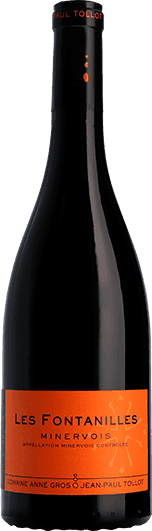
Red Blend, Languedoc
Languedoc-Roussillon · MinervoisMINERVOIS - Les Fontanilles
$38.25 Member Price$45.00 Regular